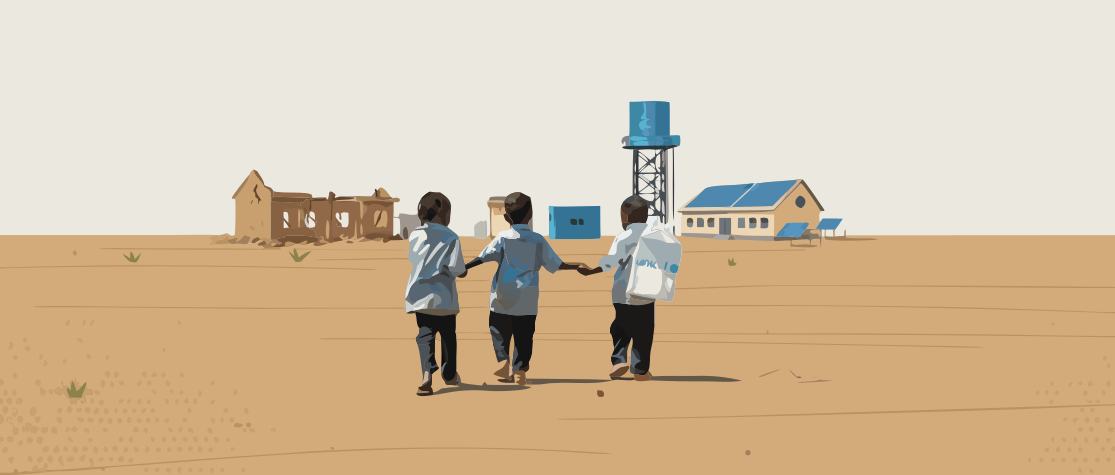
Education in Crisis
Conflict has triggered a global education emergency, leaving over
without access to learning as schools are destroyed and hope fades in war-torn regions.
Education recovery is hindered by reliance on traditional power grids and diesel generators - often damaged or hard to maintain in conflict zones - and by limited funding, with only 3% of humanitarian aid going to education.
The effect of war to children
85 million children
Explore the Crisis
Discover Solutions
520 m
children living in conflict zones
1 in 5 globally – highest ever recorded - 71 m exposed
41,763
Grave violations
verified in 2024
Up 30% from 2023 – a
373% rise since 2010
$2.7T
Global military
spending
Record high, but <2%
goes to peacebuilding
About Sudan
Sudan faces the world’s largest education emergency, with 19 million children out of school and 90% of schools closed due to ongoing conflict. Many schools have been turned into emergency shelters, disrupting learning and overcrowding the few classrooms that remain.
To restore education, Introducing solar-powered learning tools — a lifeline for a country that enjoys over 10 hours of sunshine each day, as noted by Ms. Murseli. Yet, collapsing infrastructure and unreliable electricity continue to leave schools unsafe and unusable after sunset, deepening an already dire crisis.
10,400+
Schools closed nationwide
Over 54% of schools are shut down, and 3,000 (8%) are now used as emergency shelters instead of learning spaces.
250,000
Teachers and Educators displaced
A quarter million - devastating loss of expertise.
$26 billion
Lost in lifetime earnings every year
The education collapse costs Sudan $26 billion each year, endangering its future recovery.
SOLAR ARCHITECTURE SCHOOL
In the short and long-term, the consequences of missing out on education during violent crises are severe.
Education in Emergencies
Education is a lifeline for children in crises.
Children in conflict zones face ongoing attacks and loss of education as wars persist, threatening the future of entire generations. Without schooling, they are vulnerable to exploitation and unable to rebuild their countries, deepening the crisis.
The Loss
Hotspots
Barriers
Resilience
Barriers to Learning
Conflict disrupts every layer of education: direct attacks on schools, teacher flight, the gender gap, and food insecurity. Use the interactive map below to toggle these risk layers, adjust their impact, and see how they combine to shape vulnerability.
Risk severity is shown using muted yellow (#F9C80E), burnt orange (#F86624), and deep muted red (#B70909). Each layer can be toggled, and sliders let you shift the relative influence of each risk. Explore patterns across countries and time.
Resilience and Solutions
Beyond risk lies resilience. Solution filters reveal where interventions—like mobile schools and psychosocial support—have turned the tide and given students renewed hope.
Interact with the map filters to explore these solutions. Discover how local innovation and global support are protecting learning, even in the hardest places.
Explore Urgent Causes
Let's rebuild hope together!
Get Involved
About
Methodology
Our Team
Partners
Resources
Data Sources
Stories
Contact