© 2025 Ahd Omer Basan. All rights reserved. Built with Framer | Privacy Policy
MIT Emerging Talent - Individual Project. License
To ensure every child in crisis-torn Sudan receives the lifeline of education, protecting a generation from being lost. We raise global awareness and mobilize vital donations to rebuild their future.
Our Mission
Resources
Sudan's Education Emergency in Numbers
Sudan faces one of Africa’s most severe education crises, driven by ongoing conflict, mass displacement, and attacks on schools. Over 19 million children and adolescents are out of school, many living in temporary camps with limited or no access to education. Each destroyed or militarized school deepens the long-term impact on communities, undermining social and economic recovery.
Higher Education Collapse
100+
Universities damaged.
58.6% attacked,
73.5% looted
67.6% militarized.
highest rates of attacks.
Khartoum
Omdurman
Bahri
cripples Sudan’s ability to train future professionals and rebuild.
(23 out of 34) of attacked university faculties were converted into military bases.
58
Medical Schools
The United Nations verified 1,721 grave violations against 1,526 children in Sudan amid the ongoing conflict. These included recruitment, killing, maiming, sexual violence, attacks on schools and hospitals, abductions, and denial of humanitarian access.
Violations Against Children
85+
209+
Children Recruitment
(174 boys, 35 girls) forcibly recruited by both armed groups particularly in East Sudan
1,244
Killing and Maiming
(650 boys, 386 girls) affected by crossfire, shelling, and airstrikes.
(77 Hospital, 8 Schools)
38 facilities militarized, disrupting learning.
221+
Sexual Violence
(66% girls and 33% boys.) Mainly by RSF and allied malitias
School & Hospital Attacks
These numbers reflect reported cases only.
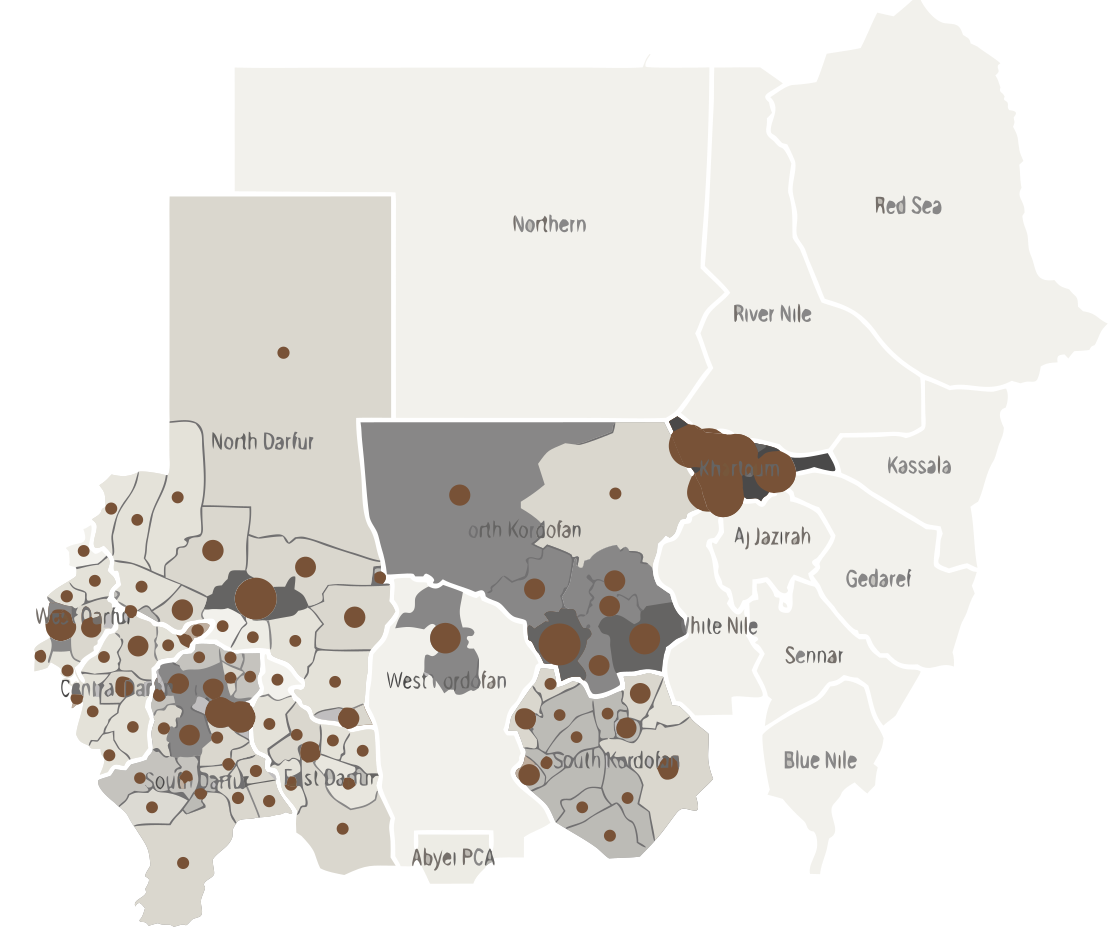
The major disruptions have been concentrated in eight of Sudan's 18 states, primarily encompassing the pivotal regions of Khartoum, Kordofan, and Darfur. These regions, historically plagued by conflict and instability, experienced the indefinite suspension of education services immediately following the onset of large-scale clashes.
The result is a severe geographical disparity in access. Two years into the conflict, there is a reported complete absence of formal education in the western and southern parts of the country. This geographical void highlights the critical link between pervasive insecurity and the total breakdown of governance necessary to maintain public services.
Geographical Mapping of Conflict Impact on Education
Pre- Conflict Fragility
Even before April 2023, Sudan's education system was fragile. 7 million children were already out of school, highlighting deep-seated issues. The pre-existing crisis meant that the education system lacked the structural resilience necessary to absorb a major shock.
40%
Third graders lacked those skills, indicating a severe foundational learning deficit.
Literacy and Numeracy Skills
The current devastation must be understood not as a sudden calamity but as an overwhelming final stressor on an already deeply fragile educational foundation. Prior to the eruption of conflict in April 2023, Sudan was already grappling with endemic poverty, political instability, and a protracted humanitarian situation involving recurrent flooding, food insecurity, and displacement.
2.1%
National Budget for Education
Public spending on education was critically low
Before Conflict Out of School
7M
From Chronic Instability to Systemic Collapse
Chronic underinvestment left teachers unpaid, with some staging sit-ins as early as 2018.
Lack of stable salaries caused high turnover and an unstable teaching workforce.
Only about 35% of primary teachers had received essential training.
These longstanding gaps created a major learning deficit that the conflict later intensified rather than caused.
This adds to the 7 million school-aged children who were out of school before the war, and continue to be deprived of their right to an education
The number of children needing life-saving education support surged from 3.7 million before the crisis to 8.6 million after the conflict erupted.
Enrolled before war
12.5M
Not back in school after 2 years.
9M
Primary Barriers to Re- entry
For the vast majority of excluded children, a combination of safety, economic, and logistical factors prevents their return, even to a 'reopened' school:
Insecurity & Fear
Continued violence, particularly in and around conflict zones, keeps children away, with families unwilling to risk dangerous journeys.
Constant Displacement
Families are frequently on the move, disrupting any attempt at consistent enrollment.
Host Community Strain
Overcrowded classrooms, lack of teachers, inadequate WASH facilities, and non-existent learning materials in receiving states place significant functional constraints on access and quality
Economic Pressure
The severe decline in urban employment (the proportion of households with full-time wage earners cut in half) forces families into desperate measures, leading to children entering labor or marriage
Pre- Conflict Fragility
Even before April 2023, Sudan's education system was fragile. 7 million children were already out of school, highlighting deep-seated issues. The pre-existing crisis meant that the education system lacked the structural resilience necessary to absorb a major shock.
40%
Third graders lacked those skills, indicating a severe foundational learning deficit.
Literacy and Numeracy Skills
The current devastation must be understood not as a sudden calamity but as an overwhelming final stressor on an already deeply fragile educational foundation. Prior to the eruption of conflict in April 2023, Sudan was already grappling with endemic poverty, political instability, and a protracted humanitarian situation involving recurrent flooding, food insecurity, and displacement.
2.1%
National Budget for Education
Public spending on education was critically low
Before Conflict Out of School
7M
From Chronic Instability to Systemic Collapse
182
353
453
444
1,504
1,118
1,568
3,796
Schools closed
Khartoum
N
K
Data: IOM
Internally Displaced People in Sudan
10.3k
563K
1M
1.2M
1.5M
1.7M
1.9M
2.1M
2.1M
2M
2.4M
3.1M
3.8M
9.1M
11.6M
9.7M
Missed Exams
1M+
Higher Education
100+
Children Displacement
4M
Missed national exams, impacting their future.
Recorded Attacks
88
3.1 million internally
1.2 million across borders, increasing vulnerability.
on educational facilities.
Universities damaged.
Schools Conversion
In Gadaref, schools serve as displacement centers halting education
Displacement Shelters

3,000+ schools are now used as emergency shelters instead of learning spaces.
Displacement and Disruption
Conflict Affected States Map
#of schools affected
0 - 41,278
41,279 - 95,954
95,955 - 177,815
177,816 - 443.780
#of children affected
0 - 19
20 - 61
62 - 122
123 - 311
312 - 824
108,273
259,745
270,674
317,820
824,669
849,605
882,855
2,401,411
West kordofan
Central Darfur
East Darfur
West Darfur
South Darfur
North Darfur
North Kordofan
Khartoum